
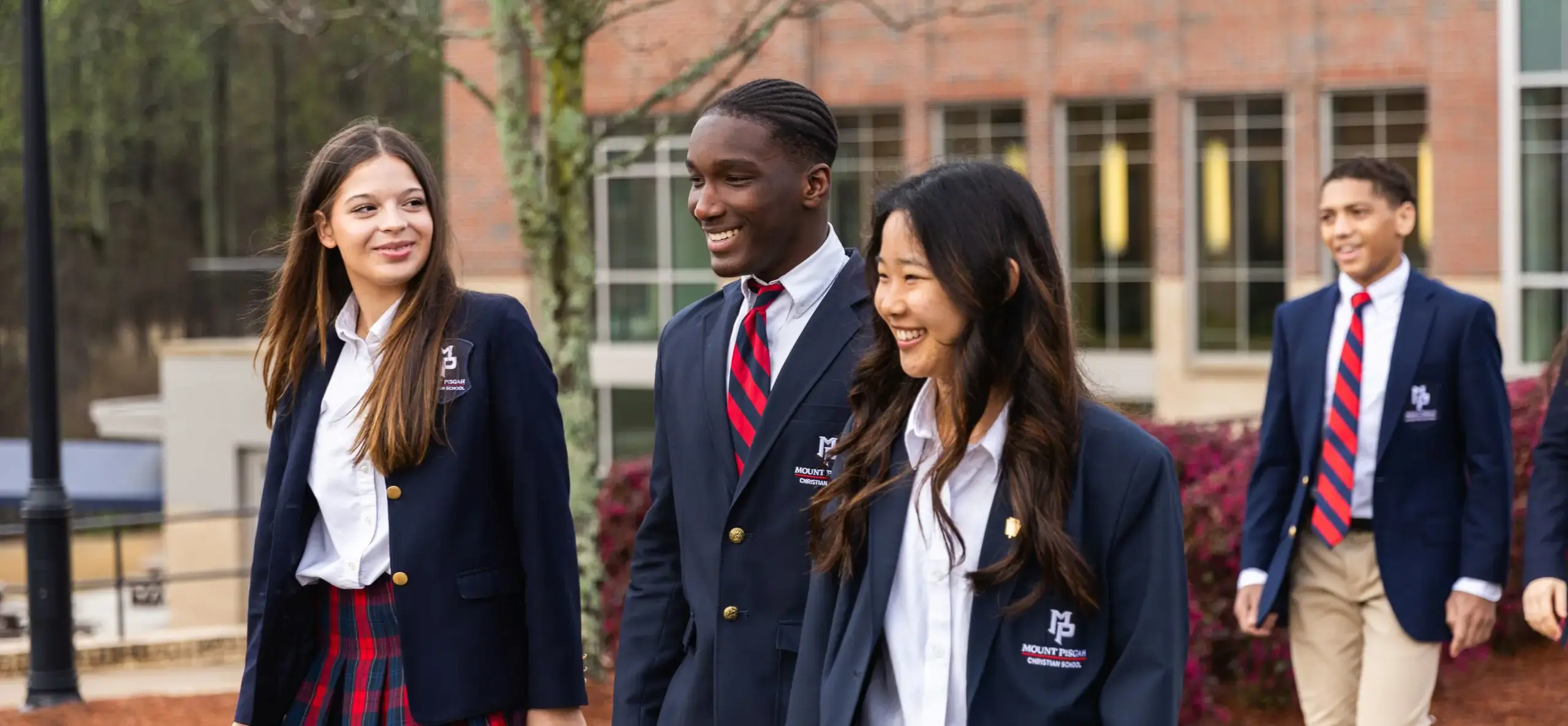
In grades 9-12, the MPCS curriculum makes connections to God, Biblical truths, and a larger Christian worldview.
Students are empowered to think critically and creatively and to act with courage and compassion. Courses are carefully aligned vertically and horizontally to ensure a robust and well-rounded education.
| ADVANCED PLACEMENT (AP) COURSES OFFERED |
|---|
|
Because all AP students take a year-end exam in May, there are specific content and skill benchmarks that the course must achieve throughout the year. All students should begin these courses with a clear understanding that the class is rigorous and maintains a fast pace. AP courses are the academic equivalent of undergraduate college-level classes and therefore require a high level of student organization, motivation, and flexibility. The most successful students in this course end the year with an understanding of university-style pacing and learning.

| 9TH GRADE ENGLISH |
|---|
| English 101, 9th Grade English, serves as a general introduction to Upper School English and is designed to develop basic skills as students mature as readers and writers. Students engage with works from genres including novels, essays, plays, and poetry. Grammar and vocabulary acquisition will be integrated with close reading textual analysis. By examining the purposes of writing, students will develop their written expression and improve their language awareness while discovering the depth and richness of literary studies. |
| AP SEMINAR |
| AP Seminar is a foundational course that engages students in cross-curricular conversations that explore the complexities of academic and real-world topics and issues by analyzing divergent perspectives. Using an inquiry framework, students practice reading and analyzing articles, research studies, and foundational, literary, and philosophical texts; listening to and viewing speeches, broadcasts, and personal accounts; and experiencing artistic works and performances. Students learn to synthesize information from multiple sources, develop their own perspectives in written essays, and design and deliver oral and visual presentations, both individually and as part of a team. Ultimately, the course aims to equip students with the power to analyze and evaluate information with accuracy and precision in order to craft and communicate evidence-based arguments. |
| PRE-AP ENGLISH I |
|
Pre-AP English I is a challenging and comprehensive language arts course designed to develop students' critical reading, analytical writing, and advanced communication skills. Through an intensive study of diverse literary genres, including novels, poetry, drama, and non-fiction texts, students will enhance their ability to analyze complex texts, develop sophisticated writing techniques, and engage in meaningful academic discourse. The course emphasizes close reading strategies, rhetorical analysis, argumentative and expository writing, and advanced research skills, preparing students for the rigorous expectations of future Advanced Placement coursework. Students will explore complex themes, develop nuanced interpretations of literature, and learn to craft well-structured, evidence-based essays that demonstrate sophisticated thinking and clear, precise communication. By integrating challenging texts from various cultural perspectives, the course not only builds essential academic skills but also promotes critical thinking, empathy, and a deeper understanding of human experiences across different contexts and time periods. |
| 10TH GRADE WORLD LITERATURE |
| This class is divided into four main focus areas: literature, grammar, composition/creative writing, and vocabulary. The course continues to build on the grammar curriculum taught in 9th-grade English. Students will demonstrate mastery of important grammatical concepts by elevating knowledge and usage of this skill set. Classical novels, from a range of nationalities, periods, cultures, and genres, are read. Each week, students complete short, creative writing assignments using the vocabulary words for the week. |
| 11TH GRADE AMERICAN LITERATURE |
|
Through the study of American literature, students not only become aware of the great, controversial, and beautiful ideas contained in America’s literary history but also examine the interactions among the writer’s purpose, subjects, and audience expectations. Assignments include expository, personal, and persuasive writing, oral expression, vocabulary development, and research and analysis. |
| AP LANGUAGE AND COMPOSITION |
| The AP English Language and Composition course cultivates reading and writing skills that students need for college success and intellectually responsible civic engagement. The course guides students in becoming curious, critical, and responsive readers of diverse texts and becoming flexible, reflective writers of texts addressed to diverse audiences for diverse purposes. The reading and writing students do in the course should deepen and expand their understanding of how written language functions rhetorically: to communicate writers' intentions and elicit readers' responses in particular situations (CollegeBoard). Class discussion is in-depth and analytical. Formal and informal writing assignments are numerous. Additionally, because the College Board recognizes this class, and the syllabus reflects collegiate standards, students enrolled in this class are held to a higher standard of maturity regarding their commitment and behavior. |
| 12TH GRADE BRITISH LITERATURE |
| Students develop an understanding of chronological context, exploring the ways in which a work is (or isn’t) shaped by the world around it. Instruction in language conventions generally occurs within the context of reading, writing and speaking, rather than in isolation. The class involves oral presentations, seminar-style discussions, research papers, timed writing, and other formal and informal assessments. |
| AP LITERATURE AND COMPOSITION |
| The AP English Literature and Composition course focuses on reading, analyzing, and writing about imaginative literature (fiction, poetry, drama) from various periods. Students engage in close reading and critical analysis of imaginative literature to deepen their understanding of the ways writers use language to provide both meaning and pleasure. As they read, students consider a work’s structure, style, and themes, as well as its use of figurative language, imagery, and symbolism. Writing assignments include expository, analytical, and argumentative essays that require students to analyze and interpret literary works (CollegeBoard). In addition, since this is a college-level class, a greater maturity is expected of the students in terms of commitment to the class. |
| AP BIOLOGY |
|---|
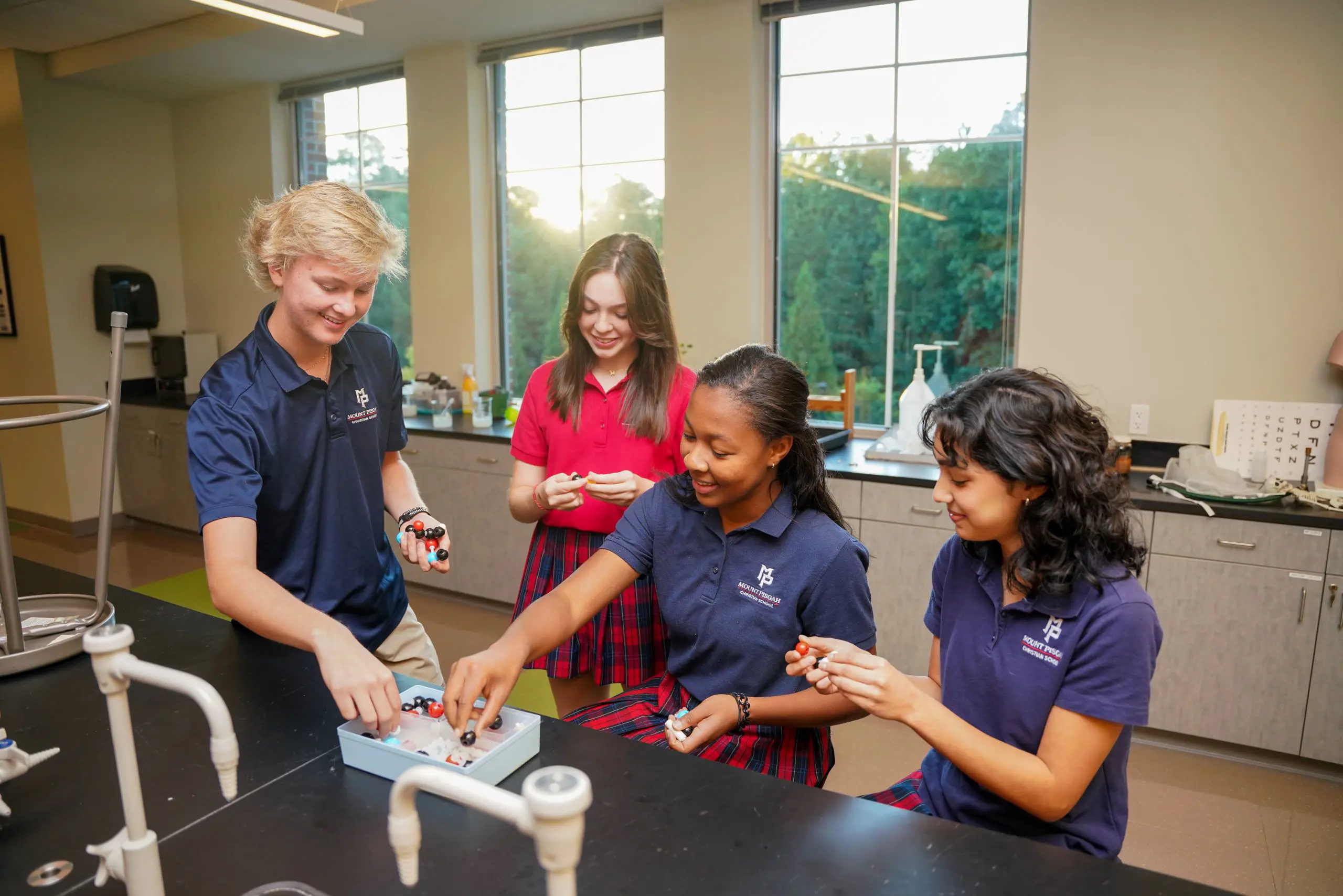
| AP Biology is an introductory college-level biology course. Students cultivate a better understanding of biology and foster science skills through inquiry-based investigations exploring the following topics: evolution, cellular processes, energy and communication, genetics, information transfer, ecology, and interactions. Laboratory work is an important part of the course, which includes thirteen AP labs. The course is based on the curriculum written by The College Board, found in the AP Biology Course and Exam Description. Students are required to take the College Board National Exam for Advanced Placement Biology to receive credit for the course. |
| AP CHEMISTRY |
| This course is comparable to general chemistry taken during the first college year. Students learn to apply the basic principles, concepts, and operations of college chemistry. Topics include atomic theory, bonding, periodicity, acid-base chemistry, oxidation-reduction, equilibrium, and thermodynamics. Students maintain a laboratory notebook and use scientific calculators to solve problems. This course requires extensive nightly home preparation. Students are required to take the Advanced Placement examination in May. Prerequisite: Honors Chemistry. |
| AP ENVIRONMENTAL SCIENCE |
| The AP Environmental Science course is designed to engage students with the scientific principles, concepts, and methodologies required to understand interrelationships within the natural world. The course requires that students identify and analyze natural and human-made environmental problems, evaluate the relative risks associated with these problems, and examine alternative solutions for resolving or preventing them. Environmental science is interdisciplinary, embracing topics from geology, biology, environmental studies, environmental science, chemistry, and geography. |
| AP PHYSICS I |
| AP Physics 1 is an algebra-based, introductory college-level physics course. Students cultivate their understanding of physics through classroom study, in-class activity, and hands-on, inquiry-based laboratory work as they explore concepts like systems, fields, force interactions, change, and conservation. Prerequisite: Geometry & concurrent Algebra II. |
| BIOLOGY |
| This course gives students an understanding of some of the major concepts of cellular biology and ecological concepts. Topics such as cell structure and function, heredity, evolution, interdependence of organisms, biochemistry, energy, and organization in living systems are taught using a variety of learning strategies. The course also addresses how science is related to career decisions, personal welfare and responsibilities as citizens, the quality of life, and the economic status of our country. Students gain knowledge and engage in the processes that enable them to solve problems and make sound decisions, establishing patterns of lifelong curiosity and learning. |
| CHEMISTRY |
| Chemistry uses experimentation, observation, and problem-solving to reinforce a study of atomic theory, bonding, periodicity, reactions, measurement, and primary states of matter. The student utilizes mathematical skills to analyze and synthesize quantitative data. Additional emphasis is placed on problem-solving, disciplined studying, and writing lab reports. The latter employs the process of critical thinking and analytical reasoning required by the scientific method. The course also emphasizes laboratory skills, safety in handling chemicals and equipment, and the ability to work in collaborative groups. |
| ENVIRONMENTAL SCIENCE |
|
This course explores some of the major concepts of environmental science. Topics such as human population growth and cultural revolutions, the advent of environmental concerns, fossil fuels, nuclear and alternative energies, air pollution and conservation, soil erosion and conservation, waste disposal and management, the cycling of Earth’s resources, interactions in biosystems are introduced through a variety of learning strategies. The course also addresses how science is related to career decisions, personal welfare and citizen responsibility, quality of life, and the economic status of our country. Students have the opportunity to gain knowledge about and engage in the processes that enable them to solve problems and make sound decisions, establishing patterns of lifelong curiosity and learning. |
| PRE-AP Biology |
|
Pre-AP Biology is an accelerated life science course designed to challenge and engage students with a comprehensive exploration of fundamental biological concepts and scientific practices. This rigorous curriculum delves into core areas such as cellular processes, genetics, evolution, ecology, and the interactions of biological systems. Students will develop critical thinking skills, engage in data analysis, and participate in hands-on laboratory investigations that emphasize the scientific method and inquiry-based learning. The course places a strong emphasis on developing scientific literacy, encouraging students to connect biological principles to real-world applications and current scientific research. Through a combination of in-depth content study, analytical reasoning, and practical experimentation, Pre-AP Biology prepares students for the demands of future AP science courses and cultivates a deep understanding of the living world. This course not only builds a solid foundation in biological sciences but also fosters the development of essential skills in scientific writing, research methodology, and collaborative problem-solving, equipping students with the tools they need to pursue advanced studies in science and related fields. |
| Pre-AP CHEMISTRY |
|
Pre-AP Chemistry is an advanced science course designed to provide students with a rigorous and comprehensive introduction to the fundamental principles of chemistry. This course emphasizes a deep understanding of atomic structure, chemical bonding, stoichiometry, gas laws, thermodynamics, and chemical reactions. Students will engage in challenging problem-solving activities, conduct sophisticated laboratory experiments, and develop critical thinking skills essential for scientific inquiry. The curriculum focuses on conceptual understanding and quantitative reasoning, encouraging students to apply their knowledge to real-world scenarios and complex chemical problems. Through a combination of theoretical study and hands-on experimentation, students will learn to analyze data, draw evidence-based conclusions, and communicate scientific findings effectively. Pre-AP Chemistry not only prepares students for success in AP Chemistry and college-level science courses but also cultivates scientific literacy and analytical skills valuable across various disciplines. This course is ideal for students who are passionate about science and seeking a challenging, in-depth exploration of chemical principles that will serve as a strong foundation for future scientific study. |
| HUMAN ANATOMY |
| This course provides a basic understanding of the structure and functions of the human body, with an emphasis on homeostasis. Study includes anatomical orientation, protection, support and movement, integration and regulation, transportation, absorption and excretion, reproduction, growth and development. This course also emphasizes laboratory skills and the ability to work in collaborative groups. |
| PHYSICS |
| Physics provides students with a conceptual understanding of physical concepts as it helps develop problem-solving skills using mathematics. Students gain a better understanding of how the world around us operates and are prepared for further college study of physics. |
| 9TH GRADE - OVERVIEW OF THE BIBLE |
|---|
| Overview of the Bible is an introductory course for all incoming freshmen, which will present important themes throughout the entirety of scripture, threading the Old and New Testaments into one holistic story. While this course will cover the main characters, events, and information presented throughout scripture, students will aim to see the Bible not simply as a disjointed collection of ancient history, but as a beautiful story communicating to us God's relationship to both the ancient world and today. Focus will be placed on where the Bible came from, the history of Israel, the beginnings of the Church, and how to apply biblical principles and teachings in our modern world. |
| 10th grade - life of christ |
| Jesus is unquestionably the most famous person that has ever lived. Was he a historical figure, a myth, or something else? This semester course will compare and contrast the four gospels as we unpack the historicity, life, death, and resurrection of Jesus. We will engage with Jesus in his first-century Jewish context, on his terms and in his words. We will specifically focus on his main message, his connection to the Old Testament, and what he reveals about the nature of God. |
| 11th grade - practical theology |
| Students will be introduced to the life and theology of the apostle Paul as they study the book of Romans. The class includes a brief biographical look into Paul’s life through the eyes of his close friend Luke in the book of Acts. As the focus of the class moves to the book of Romans, students will gain insight into the theology of Paul. Students will study the first eight chapters of the book in order to understand the essence of the gospel through Paul’s writing. |
| 12TH GRADE - WORLD RELIGIONS |
| This course surveys the foundational beliefs and practices of the world’s leading religions. Students explore and analyze what other cultures believe and why. Additionally, students view such beliefs and practices through the prism of Christianity. |

| ALGEBRA I |
|---|
| The fundamental purpose of Algebra I is to formalize and extend the mathematics that students learned in the earlier grades. Students will deepen and extend their understanding of functions and the relationships between quantities by comparing and contrasting linear and quadratic applications. Problem-solving techniques, with emphasis on accurate calculation skills, are incorporated throughout the year. |
| ALGEBRA II |
| Principle course skills in Algebra II include simplifying algebraic expressions, solving linear and quadratic equations and inequalities, factoring polynomials, applications of factoring, operations with rational expressions, complex and irrational numbers, graphing equations and inequalities, the study of functions, exponents, and logarithms. Included in the course work and derived from previous skills are many applications using basic and advanced word-problem strategies. |
| AP Pre-calculus |
|
AP Pre-calculus is designed to be the equivalent of a first semester college pre-calculus course. AP Pre-calculus provides students with an understanding of the concepts of college algebra, trigonometry, and additional topics that prepare students for further college-level mathematics courses. This course explores a variety of function types and their applications—polynomial, rational, exponential, logarithmic, trigonometric, polar, parametric, vector-valued, implicitly defined, and linear transformation functions using matrices. |
| AP CALCULUS AB |
| AP Calculus AB is designed to be the equivalent of a first semester college calculus course devoted to topics in differential and integral calculus. This course requires students to use definitions and theorems to build arguments and justify conclusions. The course features a multi-representational approach to calculus, with concepts, results, and problems expressed graphically, numerically, analytically, and verbally. Exploring connections among these representations builds understanding of how calculus applies limits to develop important ideas, definitions, formulas, and theorems. A sustained emphasis on clear communication of methods, reasoning, justifications, and conclusions is essential. |
| AP STATISTICS |
| The AP Statistics course introduces students to the major concepts and tools for formulating questions, collecting and analyzing data, and interpreting results from data. The practices and skills for the course have been aligned to help students understand the statistical problem-solving process based on the American Statistical Association (ASA) recommendations. The content, skills, and assessments in the AP Statistics course focus on exploring data, sampling and experimentation, probability and simulation, and statistical inference. Students use technology, investigations, problem solving, and writing as they build conceptual understanding. Prerequisite: Algebra II. |
| CALCULUS |
| Calculus develops students’ understanding of the concepts of calculus and providing experience with its methods and applications. The course emphasizes a multi-representational approach to calculus, with concepts, problems, and results being expressed in multiple ways. The connections among these representations also are important. Through the use of unifying themes of derivatives, integrals, limits, approximation, applications and modeling, the course becomes a cohesive whole rather than a collection of unrelated topics. |
| GEOMETRY |
| Geometry reinforces the algebraic skills students built in Algebra I while introducing the study of measurement and the properties and relationships of points, lines, angles, surfaces, and solids. Students extend their growth in problem-solving and reasoning through the study of relationships among different shapes, using techniques of inductive and deductive reasoning, including two-column proofs. Students also learn right triangle trigonometry and apply it to real-world situations. |
| Pre-AP ALGEBRA II |
| Pre-AP Algebra 2 is designed to optimize students’ readiness for college-level mathematics classes. This course extended conceptual understanding of and procedural fluency with functions and data analysis that students developed in their previous mathematics courses. |
| Pre-AP Geometry with Statistics |
| Pre-AP Geometry with Statistics is designed to provide students with a meaningful conceptual bridge between algebra and geometry to deepen their understanding of mathematics. In this course, students are expected to use the mathematical knowledge and skills they have developed previously to problem solve across the domains of algebra, geometry, and statistics. This course focuses on the foundational geometric and statistical knowledge and skills that matter most for college and career readiness. |
| PRE-CALCULUS |
| Precalculus builds on students' knowledge of the algebra function and specifically introduces logarithmic functions and rational functions. Students combine all 13 basic functions via systems of equations, function compositions, piecewise functions and sequences and series. Students blend geometric and algebraic ideas to form the foundation for trigonometry and the unit circle. Building on that foundation, students explore polar coordinates, vectors and trigonometric functions. Prerequisite: Algebra II. |
| STATISTICS AND PROBABILITY |
| Statistics is a course that introduces students to the major concepts and tools for collecting, analyzing, and drawing conclusions from data. Students cultivate their understanding of statistics using technology, investigations, problem solving, and writing as they explore concepts like variation and distribution; patterns and uncertainty; and data-based predictions, decisions, and conclusions. |

| ANCIENT WORLD HISTORY AND GEOGRAPHY |
|---|
| Ancient World History and Geography is an interdisciplinary course that helps students strengthen their historical, geographical, and analytical thinking skills. Students examine civilizations, cultures, belief systems, political structures, economics, and physical geography prior to 1200 CE while considering how patterns from the ancient world continue to shape modern social, economic, and political contexts. Through maps, primary and secondary sources, nonfiction readings, current events, discussion, writing, oral presentations, and collaborative inquiry, students learn to ask thoughtful questions, evaluate evidence, compare perspectives, and explain connections among the past, present, and future. Students also consider how the study of history and geography can help them grow in curiosity, wisdom, perspective, and responsible engagement with the world around them. |
| AP HUman Geography |
|
AP Human Geography is a college social studies course that introduces students to the systematic study of patterns and processes that have shaped human understanding, use, and alteration of Earth's surface. This rigorous curriculum explores a wide range of topics including population and migration patterns, cultural landscapes, political organization of space, agriculture and rural land use, industrialization, economic development, and urban land use. Students will develop critical thinking and analytical skills through the examination of spatial concepts, landscape analysis, and the application of geographic models. The course emphasizes the use of maps, data analysis, and case studies from various world regions to investigate human-environment interactions and global patterns. By engaging with real-world geographic issues, students will gain a deeper understanding of human social organization, its environmental consequences, and the methods and tools geographers use in their research and applications. This course not only prepares students for the AP Human Geography exam but also cultivates a global perspective essential for active citizenship in an increasingly interconnected world. Students are required to take the AP exam in May. |
| WORLD HISTORY: MODERN |
| Modern World History builds on Ancient World History and Geography by examining major global political, economic, social, cultural, and technological developments from 1200 CE to the present. Students analyze patterns of continuity and change across regions while exploring how trade, governance, belief systems, innovation, conflict, and human interaction have shaped the modern world. Through maps, primary and secondary sources, nonfiction readings, current events, discussion, research, document-based writing, argumentative essays, oral presentations, and collaborative inquiry, students strengthen their ability to evaluate evidence, compare perspectives, develop claims, and explain connections among the past, present, and future. The course helps students grow in curiosity, perspective, wisdom, and responsible engagement with the world around them. |
| AP WORLD HISTORY: MODERN |
| AP World History: Modern is a College Board-approved course that is designed to be the equivalent of an introductory college or university survey of modern world history. Students investigate significant events, individuals, developments, and processes from 1200 to the present. Students develop and use the same skills, practices, and methods employed by historians: analyzing primary and secondary sources; developing historical arguments; making historical connections; and utilizing reasoning about comparison, causation, and continuity and change over time. The course provides six themes that students explore throughout the course in order to make connections among historical developments in different times and places: humans and the environment, cultural developments and interactions, governance, economic systems, social interactions and organization, and technology and innovation. Students are required to take the AP exam in May. |
| AP UNITED STATES HISTORY |
| AP U.S. History is equivalent to a two-semester introductory college course in U.S. history. Students investigate significant events, individuals, developments, and processes in nine historical periods from approximately 1491 to the present. Students develop and use the same skills and methods employed by historians: analyzing primary and secondary sources; developing historical arguments; making historical connections; and utilizing reasoning about comparison, causation, and continuity and change. The course also provides eight themes that students explore throughout the course in order to make connections among historical developments in different times and places: American and national identity; work, exchange, and technology; geography and the environment; migration and settlement; politics and power; America in the world; American and regional culture; and social structures. Students are required to take the AP exam in May. |
| UNITED STATES HISTORY |
| U.S. History helps students develop a deeper understanding of the American experience from Pre-Columbian civilizations to the present. Students examine the major events, people, movements, conflicts, ideas, and institutions that have shaped the United States and its role in the world. Through primary and secondary sources, nonfiction readings, discussion, debate, research, essays, oral presentations, simulations, and collaborative inquiry, students strengthen their ability to analyze evidence, compare perspectives, develop historical arguments, and explain continuity and change over time. Students also consider how the study of U.S. history can help them grow in wisdom, perspective, civic responsibility, and thoughtful engagement with the world around them. |
| ECONOMICS |
| Economics is a required one-semester course that introduces students to the study of choice and how individuals, businesses, governments, and institutions shape markets and the broader economy. Students examine major principles of microeconomics, macroeconomics, personal finance, and investing while considering how economic decisions affect individuals, communities, and nations. Through discussion, case studies, simulations, nonfiction readings, data analysis, writing, debate, and collaborative inquiry, students strengthen their ability to evaluate tradeoffs, interpret economic information, solve problems, and apply economic reasoning to personal, civic, and global decisions. Students also consider how the study of economics can help them grow in wisdom, responsibility, stewardship, and thoughtful engagement with the world around them. |
| AP MICROECONOMICS |
| AP Microeconomics is equivalent to a one-semester introductory college course in economics. The course introduces students to the principles of economics that apply to the functions of individual economic decision-makers. The course also develops students’ familiarity with the operation of product and factor markets, distributions of income, market failure, and the role of government in promoting greater efficiency and equity in the economy. Students learn to use graphs, charts, and data to analyze, describe, and explain economic concepts. Students are required to take the AP exam in May. |
| GOVERNMENT |
| Government is a required one-semester course that helps students develop a deeper understanding of the history, structure, and functions of government at the local, state, and national levels. Students examine the philosophical foundations of American government, the relationship among federal, state, and local authority, and the rights and responsibilities of citizens within a constitutional system. Students also compare the American system with other forms of government in order to better understand political ideas, institutions, and civic life. Through discussion, case studies, primary and secondary sources, current events, writing, debate, simulations, and collaborative inquiry, students strengthen their ability to analyze political arguments, evaluate evidence, compare perspectives, and develop their own interpretations of American political life. Students also consider how the study of government can help them grow in wisdom, civic responsibility, discernment, and thoughtful engagement with the world around them. |
| AP UNITED STATES GOVERNMENT AND POLITICS |
| AP U.S. Government and Politics is equivalent to an introductory college course in U.S. government. The course provides a nonpartisan introduction to key political concepts, ideas, institutions, policies, interactions, roles, and behaviors that characterize the constitutional system and political culture of the United States. Students will study U.S. foundational documents, Supreme Court decisions, and other texts and visuals to gain an understanding of the relationships and interactions among political institutions, processes, and behaviors. Underpinning the required content of the course are several big ideas that allow students to create meaningful connections among concepts throughout the course. Students will also engage in skill development that requires them to read and interpret data, make comparisons and applications, and develop evidence-based arguments. In addition, they will complete a political science research or applied civics project. Students are required to take the AP exam in May. |
| LATIN I |
|---|
| The first year of Latin begins the process of comprehending the Latin language through practice and reading it. Through these readings, students develop an understanding of the social and political history of the Romans, especially during the first century A.D. |
| LATIN II |
| During this second year of Latin, students refine Latin reading skills and continue to strengthen English reading and vocabulary skills through vocabulary building and structure analysis. Through the reading selections and class discussions, students acquire more in-depth knowledge of the daily lives and history of the Romans and continue to make comparisons relevant to today’s society. Furthermore, the students also compare the effects of the geography of the ancient Roman world and that of the United States on aspects of culture, such as food, dwellings, clothing, and the arts. Intermediate and advanced writing tasks also build a bridge to understanding the written word. |
| LATIN III |
| Students in Latin 3 are moving more into the phase of reading Latin paragraphs and larger narratives. Their text has shifted from a grammatical introduction to a collection of mythological stories. The book has a graduated approach, beginning with very short, easy passages. Throughout the year we will ramp up the difficulty of both vocabulary and grammar. By the end of this year in Latin, all students will be familiar with all tenses of verbs, including the subjunctive mood. They will have covered all declensions of nouns and will have been exposed to many minutiae of the Latin language. In addition to their passages relating to mythology, they will also be reading some adapted passages from Roman authors such as Plautus, Pliny, and Vergil. Furthermore, we will dive into some well-known passages from the Latin Vulgate Bible, and will examine Roman history, both by doing research in English, and by reading passages in Latin. |
| LATIN IV |
| Our Latin 4 class seeks to accomplish two goals. For the students who will be going on to AP Latin the following year, this class provides another year of scaffolding, wherein students are presented with a comprehensive grammar review while they read Latin from original sources. Vergil’s Aeneid and Caesar’s De bello Gallico will be highlighted. For non-AP students, Latin 4 is a great survey of Roman literature. Works will include Ovid, Catullus, and Plautus, in addition to Vergil and Caesar. Throughout the year, students will encounter Roman art and architecture that augment their understanding of the written word. |
| SPANISH I |
| This course is a comprehensive introduction to the Spanish language. Students will develop basic language skills in listening, reading, speaking, and writing. Basic grammatical structures will be presented including sentence constructions, present tense of regular and irregular verbs, direct and indirect object complements as well as additional verb tenses and a deeper investigation into basic verb usage. The curriculum is based upon the five Standards in World Language Education which are communication, cultures, connections, comparisons, and communities. |
| SPANISH II |
| This course is an intermediate-level Spanish language course. Students will expand their language skills in listening, reading, speaking, and writing. Basic grammatical structures will be reviewed as complex grammatical structures will be introduced including past tense conjugations of regular and irregular verbs, the imperative tense, and the use of reflexive and reciprocal constructs. The curriculum is based upon the five Standards in World Language Education which are communication, cultures, connections, comparisons, and communities. |
| SPANISH II HONORS |
| Students in Spanish 2 Honors will build on their knowledge gained in Spanish 1. This course is designed to reinforce skills learned in Spanish 1: reading, writing, listening, and speaking. Students will be exposed to different tenses and should be able to apply them to their speaking and writing. Our central goal is for students to feel comfortable in the Spanish language and use what they know. We will also explore Spanish-speaking cultures and make cultural and linguistic comparisons with our own culture. |
| SPANISH III |
| This course is an intermediate level Spanish language course. Students will expand their language skills in listening, reading, speaking, and writing through novel units, film studies and other forms of authentic media. Novice and intermediate structures will be reviewed and expanded upon, including the use of high frequency vocabulary to communicate in the present, past and future tenses. The curriculum is based upon the five standards in World Language Education which are communication, cultures, connections, comparisons, and communities. |
| SPANISH III HONORS |
| This course is an intermediate level Spanish language course. Students will expand their language skills in listening, reading, speaking, and writing through novel units, film studies and other forms of authentic media. Novice and intermediate structures will be reviewed and expanded upon, including the use of high frequency vocabulary to communicate in the present, past and future tenses. The curriculum is based upon the five standards in World Language Education which are communication, cultures, connections, comparisons, and communities. As an honors course, students are expected to demonstrate greater independence, sustained use of the target language, and increased proficiency in both spoken and written communication. |
| SPANISH IV HONORS |
| This course is an intermediate/advanced level Spanish language course. Students will grow their language skills in listening, reading, speaking, and writing. All concepts presented in previous levels will be reviewed and examined at a higher level of detail. Learners will explore thematic units and increase their proficiency through novel units, film studies and other forms of authentic media. Novice, intermediate, and advanced structures will be reviewed and expanded upon, including the use of high frequency vocabulary to communicate in the present, past and future tenses. This course is preparatory for the AP Spanish Language exam as it introduces students to interpretive, interpersonal, and presentational modes of communication for themes present on the AP Spanish Language exam. The curriculum is based upon the five Standards in World Language Education which are communication, cultures, connections, comparisons, and communities. As an honors course, students are expected to demonstrate greater independence, sustained use of the target language, and increased proficiency in both spoken and written communication. |